The Internet loves the Myer-Briggs personality test. My Pinterest dashboard is always filled with pins relating to this test. I've visited several new blogs over the past few weeks and in almost every "About Me" page, the author states their Myer-Briggs test result in the first or second sentence, as if that is the most important thing that new readers should know about them.
For the unaware, the Myer-Briggs test was developed in the 20th century to "indicate psychological preferences in how people perceive the world and make decisions," according to Wikipedia. There are four categories with two options each:
Extraverted (E) or Introverted (I)
Sensing (S) or iNtuition (N)
Thinking (T) or Feeling (F)
Judging (J) or Perceiving (P)
These eight traits add to sixteen unique personalities.
The four traits that make up your Myer-Briggs result, however, do not make you who you are.
Let me use myself as an example.
In 2010, I took the Myer-Briggs test and my result was INFP. Let me go through each letter and tell you what that means according to the test results and according to me:
I for Introverted. According to the Myer-Briggs website, being introverted means that a person gains energy by being alone in their "inner world" of thoughts and ideas. Introverted people like reflection and they like having just a few close friends. Introverted people can also become tired from too much human interaction.
While I do enjoy my "inner world," I don't necessarily recharge from being alone in it. On the contrary, when I have a week where I stay at home, immersed in my "inner world," I am more likely to be depressed because I feel alone. I get my energy from being out of the house, whether that be hanging out with friends, going to work, or going shopping with my mom.
As you may know, I was a shy child. I could have used my Myer-Briggs result as an excuse: I'm an introvert so I'm supposed to be shy and have only a few friends. But, no; I was lonely, so I worked hard to become more outgoing. As a result, I feel comfortable talking to and joking with lots of different kinds of people now, rather than just with my close friends. I don't classify myself as an introvert; neither do I classify myself as an extravert. I have traits of both.
N for iNtuition. The Myer-Briggs website says that intuitive people trust impressions, abstract theories, and symbols more than experience and facts. Intuitive people like to see the big picture first, and then the facts.
While I do like looking at the big picture more than facts, when it comes to real-life problem-solving, I like to order my facts in a line and logically come to an answer. This is more of a Sensing trait than an iNtuition trait.
Yet, when it comes to a math, science, or multiple choice question, I often rely on my intuition. If an answer feels right, I will choose it (and then doubt myself, pick a different answer, get the question wrong, and then find out that my initial choice was right after all).
F for Feeling. The Myer-Briggs website says that people who are "feelers" are compassionate and are concerned with maintaining harmony. "Thinkers," on the other hand, look for logical solutions to problems, notice inconsistencies, and are compulsively truthful, sometimes without regard to people's feelings.
I always try to be tactful in order to spare other's feelings. I also try to "maintain harmony" because I hate confrontation. But, like I said for iNtuition, I like logical solutions. When something is illogical I act like the androids in that one Star Trek episode: "Illogical, illogical. Please explain, please explain." So, while I do have traits of a Feeling person, I have traits of a Thinker as well.
P for Perceiving. Perceivers, according to Myer-Briggs website, are spontaneous and flexible, often keeping an open schedule and working in bursts, spurred on by approaching deadlines. In contrast, judgers as task oriented and enjoy making to-do lists. Judgers like to get work done before starting leisure activities.
I am very flexible and keep an open schedule, but, other than that, I am more J than P. I can't get anything done unless I write a to-do list and order it according to priority. And, if I don't get work done before watching a movie or reading, I feel like my day has failed.
The danger with personality tests like the Myer-Briggs test is the temptation to excuse negative behavior or to ignore the opportunity for character growth. Just because I am an INFP doesn't mean that I have to be an idealist working to make the world a better place (as several INFP descriptions say), I don't have to be a perfectionist (another common INFP description I see), and I don't have to be lonely (supposedly INFPs are hard to understand and relate to since we make up about 2-4% of the population).
I'm not going to let a personality test tell me who I am. I, like everyone else on earth, am too multi-faceted for a simple personality test to explain. To steal a quote from Veggietales: "God made me special and he loves me very much." I enjoy seeing myself reflected in the descriptions for INFPs, but not enough to close the door on personal growth.
A Myer-Briggs affiliation is not a badge of honor; rather, it is a tool to help you understand yourself—both your good qualities and bad qualities. Knowing your good qualities can help you tailor your lifestyle to reflect your way of "[perceiving] the world and [making] decisions." Knowing your bad qualities can help you overcome them and become a better person because of it.
Don't let personality tests tell you who you are. Rather, let God mold you into his own image.

Thursday, June 9, 2016

Monday, June 6, 2016
The Sunday... er, Monday afternoon Report
One week in to the new blogging schedule and I completely forget to post. Oops.
How was my week? It started fantastically. Last Monday, my family and I went to see a Star Trek exhibit at a local museum! Here are some pictures:

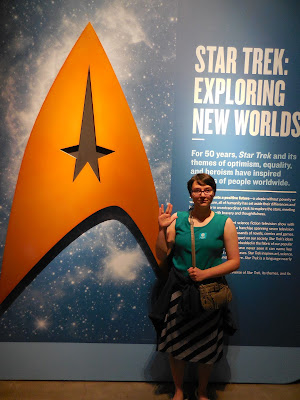


How was my week? It started fantastically. Last Monday, my family and I went to see a Star Trek exhibit at a local museum! Here are some pictures:


Sugar:
I'm still doing very well abstaining from processed sugar. There are temptations throughout the week: chocolate and caramel bars at a graduation party, cake at church, ice cream in the freezer... but if I don't concentrate on the things I can't eat and, instead, focus on the things that I can eat, I find that I'm a lot happier.
Right now we're having a heat wave (80+ degree weather in rainy Washington? Unheard of!!) and it's very hard to do anything other than lie in front of the fan. Unfortunately, the heat also makes me peckish. I suspect it's out of boredom. I snack on sunflower seeds, pumpkin seeds, and raisins. I'm also drinking a lot of water.
Exercise:
I've been doing well with exercise, though because of the heat, I'm not sure how much I'll do this week. I tried doing a cartwheel today for the first time in a few years. I can still do them... but it hurt! I guess I don't use those muscles in my every day life.
Sleep:
Getting up with my alarm is getting easier. Going to bed on time is not. I've not been doing well with having my light turned off by 11:00 PM. I'm going to keep trying, though!
Reading:
I finished two books last week. One was The Silmarillion, which I wrote a whole post about. The other was The Screwtape Letters by C.S. Lewis. I listened to the Focus on the Family radio theater-style audiobook. Andy Serkis as Screwtape was entertaining! I will have to read the book someday to glean the most out of it, though.
After finishing The Silmarillion, I started The Hobbit because I needed more Middle Earth in my life. I'm also reading Heap House by Edward Carey, which is very, very unique. The author is revealing the world, plot, and characters bit by bit, which makes the book mysterious and captivating.
Writing:
I've been working on the alien races for my sci-fi café story this week. I've also had a new story idea which is begging to be plotted. I had an idea a month or so ago that also needs plotting. Ideally, I would complete my sci-fi café story and both of these new story ideas over the summer so that I wouldn't have to do any outlining at school and could just start writing, but we'll see how far I get.
Music:
I played "Rustle of Spring" by Christian Sinding for my piano recital a few weeks ago. Here is a recording:
Now I'm working on the entirety of the "Moonlight Sonata."
My two biggest goals for this week are to memorize my songs for the voice recital and to write the VBS skits.
What's the best and worst thing that happened to you this week? What are you reading at the moment?
Thursday, June 2, 2016
Let's talk about The Silmarillion
Whenever The Silmarillion is mentioned, eyes widen, heads shake, and hands outstretch in a protective manner. The bodies that the hands belong to step backwards; mouths protest, stammering how hard J.R.R. Tolkien's history of Middle Earth is to read. Indeed, when my dad tried to read me The Silmarillion when I was about thirteen, I was so bored that I couldn't concentrate on what he was saying. We had to stop.
But, six years later, I can proudly say that I have conquered the beast! And, you know what? It wasn't so beastly after all. I read The Silmarillion, and I liked it. In fact, I enjoyed it so much, that I am going to talk to you about it for a whole blog post. If you like, you can talk back at me in the comments. I would love to hear your thoughts on this book!
The Silmarillion, as you may know, tells the history of the Elves in Middle Earth. The book is split into five parts. (Forgive me if I don't put the dots and dashes above the vowels that should have them; I don't know how to do that.)
Ainulindale
Iluvatar makes the Ainur—which are made up of the Valar and their lesser counterparts, the Maiar—and the Ainur begin singing a beautiful, harmonious song. One Ainur, however, named Morgoth, tries to hijack the music by singing discordantly. He eventually has a sing-off with Iluvatar and is stopped. The music that the remaining Ainur sing creates Arda, or, Middle Earth, where Iluvatar has plans to place Elves and men.
This was, perhaps, my favorite part of the book. There are clear parallels between Middle Earth's creation and our own world's creation as set forth in the Bible. As a musician, I loved that Middle Earth was created through song, but that evil Morgoth tried to take over by creating discord... literally. What a brilliant idea! It turns a hard-to-understand concept (good vs. evil) into something that can be understood by anyone, for discord naturally creates tension in music that even non-musicians can feel.
Valaquenta
In the second part of The Silmarillion, we learn the names of the Valar. We also learn more about Morgoth—he wants to be the sole possessor of light, but, since he cannot, he turns to evil and darkness. He corrupts other Ainur, including a Maiar named Sauron.
I found this section very confusing as we are introduced to over fourteen characters who each have two names. Actually, that is my only major complaint for the whole book. There are so many characters, which is fine, because this is a history; but do they ALL have to have two names?
Quenta Silmarillion
One of the Valar creates two trees—one that shines with a white light, and one that shines with a yellow light.
Feanor, an elf, contains the light of the two trees in three Silmarils. The Silmarils were the fairest jewels in the world. Over the next few hundred years, many battles are fought over the Silmarils until two are lost forever and the third is placed in the sky as a star.
Quenta Silmarillion is the longest section in the book. It is composed of twenty-four chapters and tells the history of the Silmarils, of the elves, and of Morgoth's rise and demise. I loved the clear line between good and evil. I loved how Tolkien showed how one, tiny seed of evil, planted by Morgoth in a good character, could twist a person and make them do the will of Morgoth (who is also called Melkor) without even realizing it.
I came across many Biblical parallels, though I'm not sure if they were intentional or not. For example, the Numenoreans reminded me of the kings in the Old Testament—they started out as followers of God, but, as generations passed, they were tempted by evil and turned away from the Lord.
Akallabeth: The Downfall of Numenor
After learning about the elves from Quenta Silmarillion, we learn the history of men in this section; specifically, the Numenoreans, who are also called the Dunedain. We learn about their kingdom of splendor that eventually falls under the corruption of Sauron. We learn that a remnant faithful to Iluvatar escapes the island of Numenor and travels to Middle Earth where they set up the kingdom of Gondor.
Of the Rings of Power and the Third Age
In the final section of The Silmarillion, Sauron corrupts both men and elves. He teaches the elves how to make rings of power, but when they put on their rings, they find that they are directly connected to Sauron's One Ring. Over time, many of the rings of power come into Sauron's possession. He gives seven of them to the dwarves and nine of them to men. As Sauron continues to rise in power, several Istari (which are Maiar in the form of men)—including Gandalf, Radagast, and Saruman—are sent to Middle Earth to help fight the powers of evil.
There is a lot of great information in this section regarding Gandalf's role in Middle Earth before and during The Hobbit. Also, it's fascinating to learn the history of the rings of power. That's one of the best things about The Silmarillion: you get to learn the history behind things only hinted at in The Hobbit and The Lord of the Rings.

One of my favorite things about The Silmarillion was its epicness. Many people are probably intimidated by the language of the book—Tolkien wrote The Silmarillion primarily in highly detailed prose; there is very little dialogue—but I loved it. Even though the book is not written in verse, it made me believe I was reading an epic like Beowulf or The Faerie Queene.
And what does every epic have in addition to amazing language? Amazing characters! Like I said, there are many characters in The Silmarillion. There are brave action heroes, wise teachers, beautiful ladies, evil double-crossers, and a lot of terribly sad tales.
In the back of my book, there were family trees and an index of names to help me keep everyone straight. It's fun to study these resources and see how this character is related to that character.

For example, did you know that Elrond and Aragorn are distantly related? Because Elrond and his brother Elros were half-human and half-elf, they were allowed to choose whether they wanted immortal life like the elves, or mortal life, like men. While Elrond chose immortal life, Elros choose the mortal life of man and, through his line, came the race of Numenoreans and, eventually, Aragorn.
I'm already anticipating when I can re-read The Silmarillion. I think I will have to read it at least twice more to glean the entire story. For now, I will start reading The Hobbit and continue listening to the "Nightfall in Middle Earth" album by Blind Guardian over and over again (Blind Guardian is a heavy metal band who created an entire album based off of The Silmarillion. My favorite song is "Time Stands Still (On the Iron Hill)," which is about Fingolfin's single combat with Morgoth).
I'm also going to start preparing for The Silmarillion Awards.
What are the Silmarillion Awards? you may ask.
The Silmarillion Awards are like the Oscars, except instead of being broadcast on television, they will be held on some of your favorite blogs (including mine), and instead of being for all genres, the prizes are specifically for fantasy characters.
Stay tuned for more information!
Have you ever read The Silmarillion? What did you think of it?
But, six years later, I can proudly say that I have conquered the beast! And, you know what? It wasn't so beastly after all. I read The Silmarillion, and I liked it. In fact, I enjoyed it so much, that I am going to talk to you about it for a whole blog post. If you like, you can talk back at me in the comments. I would love to hear your thoughts on this book!
The Silmarillion, as you may know, tells the history of the Elves in Middle Earth. The book is split into five parts. (Forgive me if I don't put the dots and dashes above the vowels that should have them; I don't know how to do that.)
Ainulindale
Iluvatar makes the Ainur—which are made up of the Valar and their lesser counterparts, the Maiar—and the Ainur begin singing a beautiful, harmonious song. One Ainur, however, named Morgoth, tries to hijack the music by singing discordantly. He eventually has a sing-off with Iluvatar and is stopped. The music that the remaining Ainur sing creates Arda, or, Middle Earth, where Iluvatar has plans to place Elves and men.
This was, perhaps, my favorite part of the book. There are clear parallels between Middle Earth's creation and our own world's creation as set forth in the Bible. As a musician, I loved that Middle Earth was created through song, but that evil Morgoth tried to take over by creating discord... literally. What a brilliant idea! It turns a hard-to-understand concept (good vs. evil) into something that can be understood by anyone, for discord naturally creates tension in music that even non-musicians can feel.
Valaquenta
In the second part of The Silmarillion, we learn the names of the Valar. We also learn more about Morgoth—he wants to be the sole possessor of light, but, since he cannot, he turns to evil and darkness. He corrupts other Ainur, including a Maiar named Sauron.
I found this section very confusing as we are introduced to over fourteen characters who each have two names. Actually, that is my only major complaint for the whole book. There are so many characters, which is fine, because this is a history; but do they ALL have to have two names?
Quenta Silmarillion
One of the Valar creates two trees—one that shines with a white light, and one that shines with a yellow light.
 |
| Picture from LadyElleth on DeviantArt |
Quenta Silmarillion is the longest section in the book. It is composed of twenty-four chapters and tells the history of the Silmarils, of the elves, and of Morgoth's rise and demise. I loved the clear line between good and evil. I loved how Tolkien showed how one, tiny seed of evil, planted by Morgoth in a good character, could twist a person and make them do the will of Morgoth (who is also called Melkor) without even realizing it.
I came across many Biblical parallels, though I'm not sure if they were intentional or not. For example, the Numenoreans reminded me of the kings in the Old Testament—they started out as followers of God, but, as generations passed, they were tempted by evil and turned away from the Lord.
Akallabeth: The Downfall of Numenor
After learning about the elves from Quenta Silmarillion, we learn the history of men in this section; specifically, the Numenoreans, who are also called the Dunedain. We learn about their kingdom of splendor that eventually falls under the corruption of Sauron. We learn that a remnant faithful to Iluvatar escapes the island of Numenor and travels to Middle Earth where they set up the kingdom of Gondor.
Of the Rings of Power and the Third Age
In the final section of The Silmarillion, Sauron corrupts both men and elves. He teaches the elves how to make rings of power, but when they put on their rings, they find that they are directly connected to Sauron's One Ring. Over time, many of the rings of power come into Sauron's possession. He gives seven of them to the dwarves and nine of them to men. As Sauron continues to rise in power, several Istari (which are Maiar in the form of men)—including Gandalf, Radagast, and Saruman—are sent to Middle Earth to help fight the powers of evil.
There is a lot of great information in this section regarding Gandalf's role in Middle Earth before and during The Hobbit. Also, it's fascinating to learn the history of the rings of power. That's one of the best things about The Silmarillion: you get to learn the history behind things only hinted at in The Hobbit and The Lord of the Rings.

One of my favorite things about The Silmarillion was its epicness. Many people are probably intimidated by the language of the book—Tolkien wrote The Silmarillion primarily in highly detailed prose; there is very little dialogue—but I loved it. Even though the book is not written in verse, it made me believe I was reading an epic like Beowulf or The Faerie Queene.
And what does every epic have in addition to amazing language? Amazing characters! Like I said, there are many characters in The Silmarillion. There are brave action heroes, wise teachers, beautiful ladies, evil double-crossers, and a lot of terribly sad tales.
In the back of my book, there were family trees and an index of names to help me keep everyone straight. It's fun to study these resources and see how this character is related to that character.

For example, did you know that Elrond and Aragorn are distantly related? Because Elrond and his brother Elros were half-human and half-elf, they were allowed to choose whether they wanted immortal life like the elves, or mortal life, like men. While Elrond chose immortal life, Elros choose the mortal life of man and, through his line, came the race of Numenoreans and, eventually, Aragorn.
I'm already anticipating when I can re-read The Silmarillion. I think I will have to read it at least twice more to glean the entire story. For now, I will start reading The Hobbit and continue listening to the "Nightfall in Middle Earth" album by Blind Guardian over and over again (Blind Guardian is a heavy metal band who created an entire album based off of The Silmarillion. My favorite song is "Time Stands Still (On the Iron Hill)," which is about Fingolfin's single combat with Morgoth).
I'm also going to start preparing for The Silmarillion Awards.
What are the Silmarillion Awards? you may ask.
The Silmarillion Awards are like the Oscars, except instead of being broadcast on television, they will be held on some of your favorite blogs (including mine), and instead of being for all genres, the prizes are specifically for fantasy characters.
Stay tuned for more information!
Have you ever read The Silmarillion? What did you think of it?
Sunday, May 29, 2016
The Sunday Night Report
Last Sunday night, I shared with you some self-improvement goals and one of those goals was to blog more often; specifically, to blog on Thursdays about whatever I want, and to blog on Sundays reflecting on whether or not I achieved the last week's goals. I've decided to include a little bit more in these Sunday evening posts, however, so the content doesn't get too boring. In addition to sharing about how well I've done with my goals, I will also share what I've been reading or writing or if I'm working on a special project. Maybe I'll even post more videos, if you are interested. I'm sure it will take a few weeks to figure out a format for these update-y posts. Or maybe they will all be different. Who knows! Stick around to find out.
Without further ado, let us get to the report:
Sugar:
It has been nearly two weeks since I gave up eating processed sugar and I'm still doing really well!
My mom and I went to Costco the other day and it was really hard not to eat their free samples. I had fun looking at food labels, though.
I had another hard-ish day today... Our church had a potluck and there were many delicious-looking, chocolate-y deserts. I told myself, "No," and then put them out of my mind. Instead, I took some sugar-free, gluten-free apple crisp that my mom made.
For snacks, I have been eating sunflower seeds, pumpkin seeds, and raisins in the prescribed serving size (1/4th of a cup a day for all three, though, so far, I have eaten less than a serving a day). Like many things, too many seeds and raisins can be bad for your health. If you eat them for a snack, don't eat more than the serving size per day.
Exercise:
At work, I clean four different industrial parks in a week. This past week, three of the four parks were being inspected so I had to make sure they were extra clean. One of these parks is nice to clean because I get to ride around in a golf cart. The other two, however, I have to walk around, carrying my bag of trash with me. On Monday and Tuesday I definitely got my exercise lugging full bags of trash around those two parks. The rest of the week I did well with exercise, too. I started doing my ab workouts again, though I took it easy since I was stricken with sciatic nerve pain on Thursday. When my sciatic nerve is bothering me, it can make even walking excruciating, but, thankfully, my mom found me some yoga poses that help ease the pain. (If you are interested, they can be found here.)
Sleep:
I've done well getting up earlier than usual, but I consistently went to bed at midnight this week. As I keep telling myself, this has to change. I just need the willpower to do it.
Reading:
I've finished the Silmaril part of The Silmarillion by J.R.R. Tolkien. I hope to finish the last two parts before the end of the month.
In the car on the way to work, I'm listening to The Screwtape Letters by C.S. Lewis. The combination of driving and listening to this radio-theater style recording isn't proving to be the most comprehensive way to absorb this book. I will have to read a physical copy of it some time in the future to glean more. I am loving Andy Serkis as Screwtape! It's fun to hear little bits of Gollum and Captain Haddock sneak into his Screwtape voice.
Project:
My project this weekend has been to pack up my American Girl Dolls. It's been a lot harder than I thought it was going to be. I remember how I got each doll. I remember the personalities and hobbies I gave each one. I remember the stories I made up for them. I remember how excited I was to buy a new outfit. It's hard to pack them away. So hard, in fact, that I haven't done it yet. I dressed them in their original outfits and put their hair in hairnets, but I haven't had the nerve to wrap them in muslin and put them in the box we bought for their safekeeping.

My goals for the coming week are to do better going to bed on time, finish the books I'm reading so that I can start some new ones, and get some kind of work done on one of my story ideas.
What's the best and worst thing that happened to you this past week?
Without further ado, let us get to the report:
Sugar:
It has been nearly two weeks since I gave up eating processed sugar and I'm still doing really well!
My mom and I went to Costco the other day and it was really hard not to eat their free samples. I had fun looking at food labels, though.
I had another hard-ish day today... Our church had a potluck and there were many delicious-looking, chocolate-y deserts. I told myself, "No," and then put them out of my mind. Instead, I took some sugar-free, gluten-free apple crisp that my mom made.
For snacks, I have been eating sunflower seeds, pumpkin seeds, and raisins in the prescribed serving size (1/4th of a cup a day for all three, though, so far, I have eaten less than a serving a day). Like many things, too many seeds and raisins can be bad for your health. If you eat them for a snack, don't eat more than the serving size per day.
Exercise:
At work, I clean four different industrial parks in a week. This past week, three of the four parks were being inspected so I had to make sure they were extra clean. One of these parks is nice to clean because I get to ride around in a golf cart. The other two, however, I have to walk around, carrying my bag of trash with me. On Monday and Tuesday I definitely got my exercise lugging full bags of trash around those two parks. The rest of the week I did well with exercise, too. I started doing my ab workouts again, though I took it easy since I was stricken with sciatic nerve pain on Thursday. When my sciatic nerve is bothering me, it can make even walking excruciating, but, thankfully, my mom found me some yoga poses that help ease the pain. (If you are interested, they can be found here.)
Sleep:
I've done well getting up earlier than usual, but I consistently went to bed at midnight this week. As I keep telling myself, this has to change. I just need the willpower to do it.
Reading:
I've finished the Silmaril part of The Silmarillion by J.R.R. Tolkien. I hope to finish the last two parts before the end of the month.
In the car on the way to work, I'm listening to The Screwtape Letters by C.S. Lewis. The combination of driving and listening to this radio-theater style recording isn't proving to be the most comprehensive way to absorb this book. I will have to read a physical copy of it some time in the future to glean more. I am loving Andy Serkis as Screwtape! It's fun to hear little bits of Gollum and Captain Haddock sneak into his Screwtape voice.
Project:
My project this weekend has been to pack up my American Girl Dolls. It's been a lot harder than I thought it was going to be. I remember how I got each doll. I remember the personalities and hobbies I gave each one. I remember the stories I made up for them. I remember how excited I was to buy a new outfit. It's hard to pack them away. So hard, in fact, that I haven't done it yet. I dressed them in their original outfits and put their hair in hairnets, but I haven't had the nerve to wrap them in muslin and put them in the box we bought for their safekeeping.

My goals for the coming week are to do better going to bed on time, finish the books I'm reading so that I can start some new ones, and get some kind of work done on one of my story ideas.
What's the best and worst thing that happened to you this past week?
Thursday, May 26, 2016
Why I've Stopped Eating Sugar
In January of 2015, my family did the Whole 30, which is an eating plan where you only eat "whole" foods—i.e. fruits, vegetables, and meat; no grain, sugar, dairy, soy, or legumes—for thirty days. When we added the forbidden foods back into our diets, sugar was the only one that made me feel sick. Over the past year-and-a-half, however, my body has re-adjusted to eating sugar.
On Monday, May 16, I watched a documentary called "That Sugar Film." In this documentary, an Australian man eats 40 teaspoons (the daily average sugar intake for an Australian) of hidden sugar a day for sixty days. He stays away from ice cream, candy, fast food, and soft drinks, but, instead, eats yogurts, juices, granola, and other "healthy" foods. In sixty days, he gains weight and he presents signs of heart disease, liver disease, and diabetes.
After watching this documentary, I looked at my cereal box and was astonished to find out that my "healthy" granola contains three teaspoons of sugar in one serving (2/3rds of a cup)! Now, seeing that on a box may not seem like much, but when you measure it out in a measuring cup, that's a lot of sugar! Just thinking about that much sugar for one meal made me feel sick, so I decided to go with my gut (literally) and give up sugar again.
I didn't want to make a blind decision, though, so I started researching processed sugar's effect on the body and brain. As I read more and more, I became more and more disgusted and concerned, and confidant that I had made the right decision.
There are three different types of sugar to be aware of: one is glucose. Glucose is found in every cell in the body and is necessary for human survival. If we don't eat enough glucose, our body produces it. Glucose is what gives us energy. If we already have enough energy, glucose is turned into glycogen and saved for later. Carbohydrates are turned into glucose and, like nearly anything, if you eat too much, it may have negative benefits. It is, however, important to have some kind of carbohydrate in your diet, whether that be simple carbs like grains, or complex carbs like fruits and vegetables.
The second type of sugar is fructose. Fructose is found in fruits, but is also added to about 80% of food found in the store. During the low-fat movement of the 1970s, fat in food was deemed unhealthy and taken out of many foods. To compensate for this, food manufactures added sugar to their products so that it would still taste good. Therefore, many foods that are supposedly healthy—such as low-fat yogurt—are actually unhealthy because of how much fructose they contain.
While glucose is easily turned into energy, fructose is not, especially if eaten in large quantities. The liver, where sugar is processed before being sent into the bloodstream, doesn't know what to do with large quantities of fructose. If it can't be used for immediate energy, the liver will turn it into fat and send it into the bloodstream. At the same time that the liver is sending glucose and fructose into the bloodstream, the pancreas is sending insulin into the bloodstream. The more sugar that is in the blood, the more insulin is sent. Insulin helps turn glucose into energy but, like the liver, it doesn't know what to do with fructose so it tends to hover around it aimlessly.
The third type of sugar is sucrose and is made up of glucose and fructose.
There are several reasons sugar—specifically sucrose and fructose—are bad for our bodies. Fructose that has been turned into fat by the liver can stay in the liver, causing fatty liver disease. This fat could also travel into the bloodstream and cause blockages leading to heart problems. Eating too much sugar can also lead to insulin resistance and diabetes. And, of course, sugar rots your teeth and makes you fat. Additionally, sugar can inhibit the hormone that tells your body that it's full. It has also been shown that sugar affects learning, memory, and can even contribute to anxiety and stress.
While these are good reasons to give up sugar, they are not the primary reason I chose to give up sugar. I chose to give up sugar because of what it does to mood and the brain.
According to the articles I have read, sugar represses a hormone nicknamed BDNF, which is important for mental health. Depressed people often have low BDNF. Sugar also causes inflammation, which is associated with depression.
Often, when people are sad or depressed, their first reaction is to grab a chocolate bar or a bowl of ice cream because sugar makes them feel better. This is because sugar activates the pleasure center in the brain. The pleasure center releases dopamine, the reward chemical. This good feeling is accompanied by an energy spike (or, "sugar rush"). But, as the sugar runs out, so does the good feeling and the energy. It is replaced with irritability and tiredness. So, in order to release more dopamine to make us feel good, we eat more sugar. And more. And more. Eventually, this could lead to a sugar addiction as the brain becomes reliant on the dopamine and energy spikes caused by sugar. The same part of the brain that is activated by addictive drugs and alcohol is also activated by sugar.
I don't want to be addicted to sugar. I don't want to rely on it, especially if it contributes to depression, with which I already struggle..
So, I've stopped eating it. It's only been ten days, but I can already tell differences:
1. My teeth are cleaner. Instead of brushing them for four minutes with my Sonicare toothbrush, I only need to brush them for two.
2. I am fuller, longer. When I ate cereal for breakfast, it would keep me energized for two hours or so and then I would feel hungry again. Now, eating eggs (and bacon or avocado) for breakfast, I can work for three or four hours before getting hungry.
3. I don't have a foggy brain anymore. I used to wake up every morning feeling like my head was surrounded by a cumulus cloud. No longer! The cloud has blown away. Giving up processed sugar has given me a clear head.
But, Abbey, what about the sugar in fruit??
God created fruit to contain sugar, nutrients, and fiber. The fiber and nutrients slow down digestion so that the sugar doesn't enter the liver all at once, like it would if you ate a candy bar or drank a soda.
Now, this doesn't mean that fruit juice, dried fruit, or even smoothies are healthy. Fruit juice takes the fiber and presents you with only the sugary juice, dried fruit condenses the sugar into a tiny package, and smoothies can be made with sugar. I, however, still eat and drink these things. But, I do it in moderation. If I drink a glass of juice, I make sure it's in a four-ounce glass. I try not to eat too much dried fruit, but I do love raisins (someone has to)... When I make smoothies, I make sure to use the whole fruit so that I keep in the fiber and other nutrients. Still, smoothies are a little bit over-the-top. After all, you wouldn't sit down and eat ten strawberries, a handful of blueberries and raspberries, a mango, a peach, and a banana is one sitting, would you?
I vlogged my first nine days of being sugar-free. If you're interested, check out the video:
I'm not a nutritionist and eating sugar-free is not for everyone. Though sugar has come under interrogation in the past ten years, there are still many people who are unaware of its negative effects and of its prevalence in our food. I have tried to present my research as I've understood it, so I apologize if I've gotten anything wrong (and all my sources are from the Internet, so there's always that liability). I hope you've learned something from this post!
One last note... 4 grams of sugar equals one teaspoon of sugar. 4g=1tsp. It's fun and interesting to pull items from the shelf or the refrigerator and calculate exactly how much sugar you eat in one meal. Try it, and let me know in the comments what you find!
On Monday, May 16, I watched a documentary called "That Sugar Film." In this documentary, an Australian man eats 40 teaspoons (the daily average sugar intake for an Australian) of hidden sugar a day for sixty days. He stays away from ice cream, candy, fast food, and soft drinks, but, instead, eats yogurts, juices, granola, and other "healthy" foods. In sixty days, he gains weight and he presents signs of heart disease, liver disease, and diabetes.
After watching this documentary, I looked at my cereal box and was astonished to find out that my "healthy" granola contains three teaspoons of sugar in one serving (2/3rds of a cup)! Now, seeing that on a box may not seem like much, but when you measure it out in a measuring cup, that's a lot of sugar! Just thinking about that much sugar for one meal made me feel sick, so I decided to go with my gut (literally) and give up sugar again.
I didn't want to make a blind decision, though, so I started researching processed sugar's effect on the body and brain. As I read more and more, I became more and more disgusted and concerned, and confidant that I had made the right decision.
There are three different types of sugar to be aware of: one is glucose. Glucose is found in every cell in the body and is necessary for human survival. If we don't eat enough glucose, our body produces it. Glucose is what gives us energy. If we already have enough energy, glucose is turned into glycogen and saved for later. Carbohydrates are turned into glucose and, like nearly anything, if you eat too much, it may have negative benefits. It is, however, important to have some kind of carbohydrate in your diet, whether that be simple carbs like grains, or complex carbs like fruits and vegetables.
The second type of sugar is fructose. Fructose is found in fruits, but is also added to about 80% of food found in the store. During the low-fat movement of the 1970s, fat in food was deemed unhealthy and taken out of many foods. To compensate for this, food manufactures added sugar to their products so that it would still taste good. Therefore, many foods that are supposedly healthy—such as low-fat yogurt—are actually unhealthy because of how much fructose they contain.
While glucose is easily turned into energy, fructose is not, especially if eaten in large quantities. The liver, where sugar is processed before being sent into the bloodstream, doesn't know what to do with large quantities of fructose. If it can't be used for immediate energy, the liver will turn it into fat and send it into the bloodstream. At the same time that the liver is sending glucose and fructose into the bloodstream, the pancreas is sending insulin into the bloodstream. The more sugar that is in the blood, the more insulin is sent. Insulin helps turn glucose into energy but, like the liver, it doesn't know what to do with fructose so it tends to hover around it aimlessly.
The third type of sugar is sucrose and is made up of glucose and fructose.
There are several reasons sugar—specifically sucrose and fructose—are bad for our bodies. Fructose that has been turned into fat by the liver can stay in the liver, causing fatty liver disease. This fat could also travel into the bloodstream and cause blockages leading to heart problems. Eating too much sugar can also lead to insulin resistance and diabetes. And, of course, sugar rots your teeth and makes you fat. Additionally, sugar can inhibit the hormone that tells your body that it's full. It has also been shown that sugar affects learning, memory, and can even contribute to anxiety and stress.
While these are good reasons to give up sugar, they are not the primary reason I chose to give up sugar. I chose to give up sugar because of what it does to mood and the brain.
According to the articles I have read, sugar represses a hormone nicknamed BDNF, which is important for mental health. Depressed people often have low BDNF. Sugar also causes inflammation, which is associated with depression.
Often, when people are sad or depressed, their first reaction is to grab a chocolate bar or a bowl of ice cream because sugar makes them feel better. This is because sugar activates the pleasure center in the brain. The pleasure center releases dopamine, the reward chemical. This good feeling is accompanied by an energy spike (or, "sugar rush"). But, as the sugar runs out, so does the good feeling and the energy. It is replaced with irritability and tiredness. So, in order to release more dopamine to make us feel good, we eat more sugar. And more. And more. Eventually, this could lead to a sugar addiction as the brain becomes reliant on the dopamine and energy spikes caused by sugar. The same part of the brain that is activated by addictive drugs and alcohol is also activated by sugar.
I don't want to be addicted to sugar. I don't want to rely on it, especially if it contributes to depression, with which I already struggle..
So, I've stopped eating it. It's only been ten days, but I can already tell differences:
1. My teeth are cleaner. Instead of brushing them for four minutes with my Sonicare toothbrush, I only need to brush them for two.
2. I am fuller, longer. When I ate cereal for breakfast, it would keep me energized for two hours or so and then I would feel hungry again. Now, eating eggs (and bacon or avocado) for breakfast, I can work for three or four hours before getting hungry.
3. I don't have a foggy brain anymore. I used to wake up every morning feeling like my head was surrounded by a cumulus cloud. No longer! The cloud has blown away. Giving up processed sugar has given me a clear head.
But, Abbey, what about the sugar in fruit??
God created fruit to contain sugar, nutrients, and fiber. The fiber and nutrients slow down digestion so that the sugar doesn't enter the liver all at once, like it would if you ate a candy bar or drank a soda.
Now, this doesn't mean that fruit juice, dried fruit, or even smoothies are healthy. Fruit juice takes the fiber and presents you with only the sugary juice, dried fruit condenses the sugar into a tiny package, and smoothies can be made with sugar. I, however, still eat and drink these things. But, I do it in moderation. If I drink a glass of juice, I make sure it's in a four-ounce glass. I try not to eat too much dried fruit, but I do love raisins (someone has to)... When I make smoothies, I make sure to use the whole fruit so that I keep in the fiber and other nutrients. Still, smoothies are a little bit over-the-top. After all, you wouldn't sit down and eat ten strawberries, a handful of blueberries and raspberries, a mango, a peach, and a banana is one sitting, would you?
I vlogged my first nine days of being sugar-free. If you're interested, check out the video:
I'm not a nutritionist and eating sugar-free is not for everyone. Though sugar has come under interrogation in the past ten years, there are still many people who are unaware of its negative effects and of its prevalence in our food. I have tried to present my research as I've understood it, so I apologize if I've gotten anything wrong (and all my sources are from the Internet, so there's always that liability). I hope you've learned something from this post!
One last note... 4 grams of sugar equals one teaspoon of sugar. 4g=1tsp. It's fun and interesting to pull items from the shelf or the refrigerator and calculate exactly how much sugar you eat in one meal. Try it, and let me know in the comments what you find!
Subscribe to:
Posts (Atom)